Piriformis Pain or Sciatica? Combined Soft Tissue Techniques for Low Back and Buttock Tension

Piriformis Pain or Sciatica? Combined Soft Tissue Techniques for Low Back and Buttock Tension

Quick answer: Buttock pain that travels into the leg can have different causes. Sciatica describes symptoms linked to irritation or compression of the sciatic nerve; the piriformis is one muscle in the deep buttock area, and symptoms can overlap. A Deep Tissue Massage cannot diagnose the cause or cure nerve compression. When massage is suitable, an assessment-led approach may combine focused soft tissue work with comfortable movement or stretching, rather than relying on heavy pressure in one spot.

A deep ache in one buttock, tightness around the hip or pain that travels down the back of the leg can make you wonder whether the piriformis is involved or whether it is sciatica. The names are often mixed up, but they do not mean the same thing. This guide explains the difference and how a considered massage session may fit into a wider plan for comfort and movement.

Book your professional Massage in Bath.

Piriformis pain and sciatica: what is the difference?

Sciatica is a symptom pattern associated with irritation or compression of the sciatic nerve. It commonly affects the buttock and the back of one leg, sometimes reaching the foot. People may notice sharp or burning pain, tingling, numbness or weakness. The source is often in the lower back, so pain down the leg does not automatically mean the piriformis muscle is responsible.

The piriformis is a small, deep muscle in the buttock. Sensitivity in this area can be one possible contributor to buttock or hip discomfort, and the symptoms may resemble sciatica. However, the pattern alone cannot confirm what is causing the pain. A GP or physiotherapist can assess symptoms that persist, worsen or affect everyday activities.

Why a combined approach can be more thoughtful

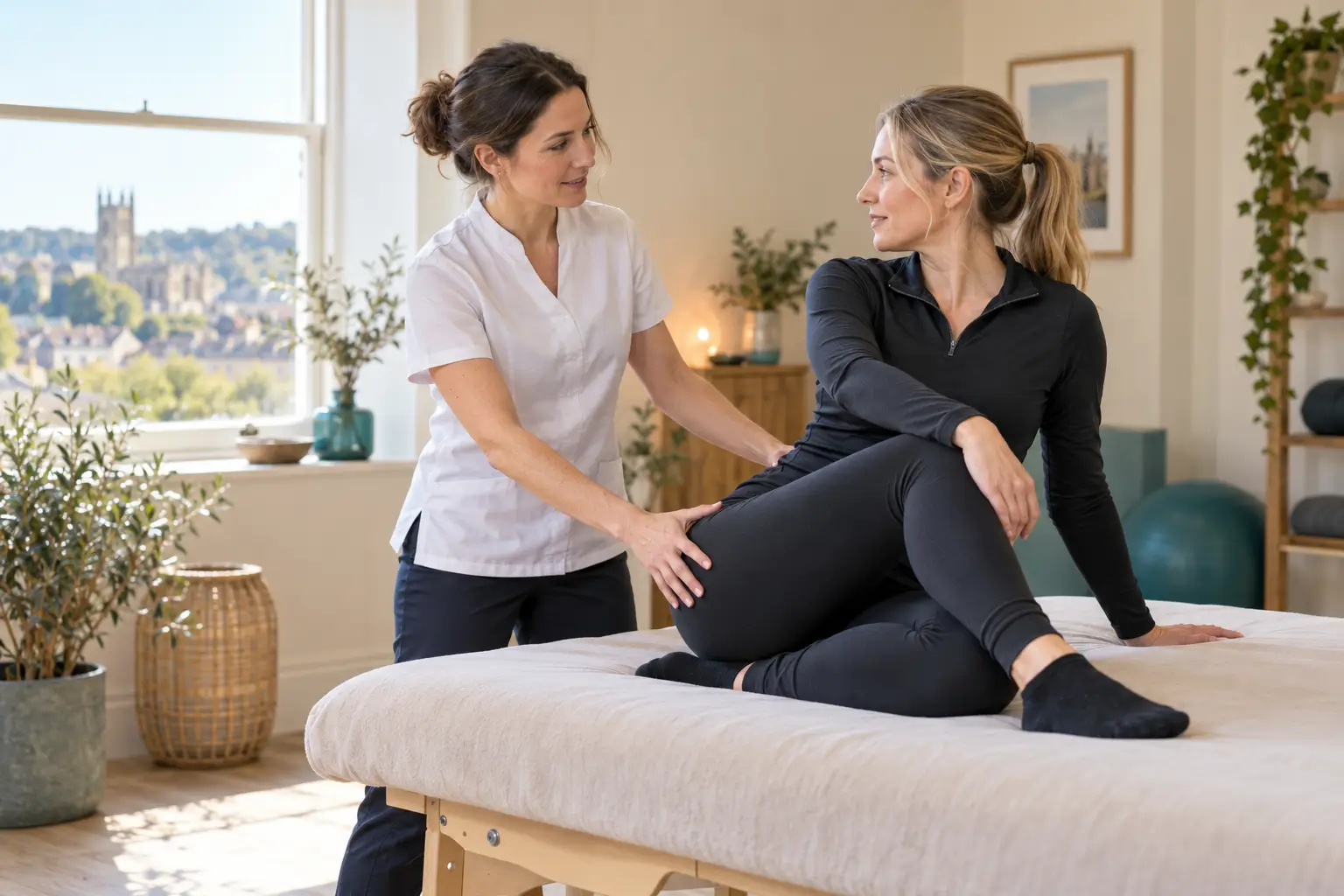
A sports massage-informed approach is not simply about using more pressure. It starts by asking about your activity, when the symptoms began, what makes them better or worse, and what you would like to be able to do. The therapist then agrees a focus with you and chooses only techniques that are appropriate to the findings, your comfort and their training.

For some people, a session may include slower, focused Deep Tissue Massage on selected muscles around the lower back, hip and buttock. A therapist may also use specific work on tender points or gentle stretching when appropriate. Combining approaches does not mean using every technique in one appointment: the aim is to choose a suitable sequence and check how your body responds as the session progresses.

Pressure should never be a test of endurance. Deep Tissue Massage can feel focused, but it should be adjusted to your feedback. If a movement or pressure creates sharp, electric or spreading pain down the leg, tell the therapist so they can stop or change the approach. The sciatic nerve is not something to press hard on in an attempt to “release” it.

What can massage realistically do?

Massage may help some people feel more comfortable in muscles that feel tight or overworked, but it cannot identify the medical cause of sciatica or promise to fix a compressed nerve. NHS guidance includes massage as one manual-therapy technique that may be used within physiotherapy, alongside exercise advice. That is different from claiming that a stand-alone Deep Tissue Massage cures sciatica.

A useful session should also leave room for simple aftercare. Depending on your situation, that could mean comfortable movement, a gentle stretch or a suggestion to follow up with a GP or physiotherapist. Advice should be individual; avoid forcing a stretch or repeating anything that increases leg symptoms.

When to seek medical advice

Contact your GP if leg pain has not improved after a few weeks, is getting worse or is stopping normal activities. Seek urgent help through A&E or call 999 if you have sciatica on both sides, severe or worsening weakness or numbness in both legs, numbness around the genitals or bottom, or new difficulty controlling your bladder or bowels. These symptoms need urgent medical assessment, not a massage appointment.

Deep Tissue Massage in Bath at Mediterranean Therapy

At Mediterranean Therapy in Bath, a Deep Tissue Massage begins with a conversation about your symptoms, activity and comfort. If massage is suitable, the focus and pressure are adapted to you. Read about the Deep Tissue Massage treatment or contact the studio with a question.

Frequently Asked Questions

No. It cannot diagnose or guarantee a cure for sciatica or nerve compression. Massage may support muscular comfort for some people and can be considered as part of a wider care plan.

No. Sciatica describes symptoms associated with the sciatic nerve. The piriformis is one possible source of buttock discomfort, and the symptoms can overlap. A massage therapist cannot confirm the diagnosis.

No. Pressure should be agreed and adjusted to your feedback. Sharp, electric or spreading pain is a reason to tell your therapist to stop or change the technique.

Visit Me for Your Massage in Bath

Enjoy your treatment at Mediterranean Therapy, located inside The Soul Spa a serene, centrally located wellness space in the heart of Bath:

📍 2 Hetling Court, Bath. Tel: 07378275075
👉 Click and get directions

Relax with a massage. Your expert massage therapist in Bath is ready to help you restore balance and calm, the best experience massage in Bath.

Teresa - Your Spa Therapist

Teresa - Your Spa Therapist

Massage therapist, facials and skincare with 5 star hotel experiences, an expert in a wide range of treatments.

Mediterranean Therapy
2 Hetling Court Bath - Tel: 07378275075

Massage Therapist Posts

Massage & Rejuvenation Services

  • Back, Neck & Shoulder
    Back, Neck & Shoulder

    30 mins – Click to Book!

    £ 35
  • Couple Massage
    Couple Massage

    1 hour – Click to Book!

    £ 140
  • Deep Tissue Massage
    Deep Tissue Massage

    1 hour – Click to Book!

    £ 70
  • Lymphatic Drainage Massage
    Lymphatic Drainage Massage

    1 hour – Click to Book!

    £ 70
  • Hot Stone Massage
    Hot Stone Massage

    1 hour – Click to Book!

    £ 70
  • Pregnancy Massage
    Pregnancy Massage

    1 hour – Click to Book!

    £ 70

Follow me on Social Media

Piriformis Syndrome or Sciatica? Why Buttock Pain Can Travel Down the Leg

Piriformis Syndrome or Sciatica? Why Buttock Pain Can Travel Down the Leg

A deep ache in one buttock. A pulling sensation through the hip. Burning, tingling or discomfort that seems to travel down the back of the leg.

Many people experiencing these symptoms immediately think: “Is this sciatica?”

Sometimes it may be. But pain around the buttock, hip and leg can have different causes, and one area that often attracts attention is a small, deep muscle called the piriformis.

Sciatica and piriformis-related pain can feel surprisingly similar. This is one reason why simply massaging the exact spot that hurts isn’t always the best way to understand what your body is experiencing.

The lower back, pelvis, hips, gluteal muscles and legs work together. Tension or irritation in one area can sometimes be felt somewhere else.

Understanding these connections can help explain why a thoughtful massage treatment may involve much more than the painful area itself.

Book your professional Massage in Bath.

What Exactly Is Sciatica?

Sciatica isn’t simply another name for lower back pain.

The term describes symptoms associated with irritation or compression involving the sciatic nerve or the nerve roots that form it.

The sciatic nerve is the largest nerve in the body. It originates from nerve roots in the lower spine and travels through the pelvic and buttock region before continuing down the leg.

Typical symptoms can include:

•  pain beginning around the lower back or buttock and travelling down one leg
•  burning or shooting pain
•  pins and needles or tingling
•  numbness
•  occasionally weakness in the affected leg or foot.

For some people the discomfort is relatively mild. For others it can make sitting, walking, driving or sleeping uncomfortable.

Importantly, true sciatica frequently has its origin around the lumbar spine, rather than in the muscles of the buttock themselves.

That distinction matters.

So What Is the Piriformis?

The piriformis is a relatively small muscle located deep within the buttock.

It connects the sacral region to the upper part of the femur and contributes to movement and stability around the hip.

Although it is small, its location makes it particularly interesting.

The sciatic nerve normally passes very close to the piriformis, and anatomical relationships between the muscle and nerve vary between individuals.

When structures within this deep gluteal region become irritated, symptoms may sometimes resemble sciatica.

This is where the term piriformis syndrome is often used.

Piriformis Syndrome vs Sciatica: What’s the Difference?

This is the difficult part because the symptoms can overlap.

Piriformis syndrome is generally used to describe symptoms thought to result from irritation or compression of the sciatic nerve around the piriformis/deep gluteal region.

Someone may experience:

•  deep buttock pain
•  tenderness around the gluteal area
•  discomfort when sitting for long periods
•  hip discomfort
•  pain that sometimes travels into the back of the thigh or further down the leg.

Sciatica arising from the lumbar spine can also produce buttock and leg pain.

From the person’s perspective, therefore, both can simply feel like:

“I have pain in my bum and it goes down my leg.”

This is exactly why self-diagnosing piriformis syndrome from symptoms alone can be misleading.

The piriformis may be involved but it isn’t automatically the cause.

Why the Place That Hurts Isn’t Always the Source

One of the most useful concepts in musculoskeletal therapy is that the location of pain doesn’t always tell us where the problem started.

Imagine someone arriving for a massage saying:

“It hurts here.”

They point to the middle of their right buttock.

It would be easy to assume that the solution is simply to apply deep pressure directly to that spot.

But the body doesn’t always work that way.

A therapist may need to consider the surrounding areas too:

Lower back → pelvis → glutes → piriformis → hip → hamstrings → leg

Muscles and joints don’t function independently. They influence one another through movement, posture, loading and compensation.

This broader way of looking at muscular pain is particularly relevant when someone experiences recurring tightness rather than a straightforward post-exercise ache.

Why Might the Piriformis and Glutes Become Tight?

There isn’t one universal explanation.

Different lifestyles place different demands on the hips and gluteal muscles.

Sitting for long periods

Long periods at a desk, driving or travelling can leave the hips feeling stiff and the gluteal area uncomfortable.

Some people particularly notice deep buttock pain after getting out of a chair or car.

Running and sport

Running, cycling, hiking and sports involving repeated hip movement place significant demands on the gluteal muscles and hip stabilisers.

This doesn’t mean exercise is harmful quite the opposite but increased training loads or changes in activity can sometimes be accompanied by muscular tension.

Repetitive physical work

Jobs involving standing, bending, lifting or repeated movement can create their own patterns of muscular fatigue.

Changes in movement

An uncomfortable knee, ankle or lower back may subtly change the way someone walks or moves.

Over time, another part of the body may begin doing more work.

Again, this illustrates why treating only the painful point may miss part of the picture.

Can Tight Glutes Cause Pain Down the Leg?

Muscular tension in the gluteal region can certainly contribute to discomfort around the buttock and hip.

However, pain travelling down the leg particularly when accompanied by numbness, tingling or weakness shouldn’t automatically be blamed on a tight muscle.

Nerves behave differently from muscles.

A tight muscle may feel achy, tender or restricted. Neural symptoms may feel burning, electric, shooting, numb or tingly.

There can also be overlap.

For a massage therapist, recognising that distinction is important because aggressive deep tissue work isn’t necessarily appropriate simply because somebody asks for a “really deep massage”.

Sometimes less pressure and more careful assessment are the better choices.

Can Massage Help Sciatica or Piriformis-Related Pain?

Massage cannot correct every underlying cause of sciatica, and a massage therapist should not claim to diagnose or cure a neurological condition.

However, massage may be helpful for associated muscular tension, stiffness and discomfort, depending on what is contributing to the person’s symptoms.

For example, treatment might focus on tension involving the:

•  gluteal muscles
•  deep external hip rotators
•  lower back muscles
•  hip area
•  hamstrings
•  surrounding soft tissues

The aim isn’t simply to “push on the sciatic nerve”.

In fact, directly and aggressively pressing onto an irritated nerve would not be appropriate.

Instead, massage may be used to help reduce surrounding muscular tension and encourage more comfortable movement.

Deep Tissue Massage for Buttock, Hip and Lower Back Tension

People searching online for deep tissue massage in Bath often assume that deep tissue means the therapist simply presses harder.

Good deep tissue work should be more considered than that.

Pressure should be adapted according to the tissue, the individual and the symptoms present.

When treating persistent gluteal or hip tension, a session may include slower, focused techniques directed towards relevant muscle groups rather than using maximum pressure everywhere.

This is particularly important around sensitive areas such as the deep gluteal region.

Effective doesn’t necessarily mean painful.

What About Sports Massage?

You don’t need to be an athlete to benefit from principles commonly associated with sports massage.

Sports and therapeutic massage approaches often consider movement patterns, muscular loading, areas of restriction and how different tissues may be interacting.

This can be useful for runners, cyclists and gym users — but equally for somebody who spends eight hours sitting at a computer or driving.

A person may come in complaining of one painful glute, yet the treatment may also involve the lower back, hips or legs depending on what is found.

The goal is to treat the person rather than chase a single painful point.

Trigger Points and Referred Pain

Another concept worth understanding is referred pain.

A sensitive area within a muscle can sometimes produce discomfort that is perceived somewhere else.

This means that the point where you feel pain isn’t necessarily the only place worth considering.

Trigger point techniques are sometimes incorporated within deep tissue or therapeutic massage when appropriate.

This subject deserves an article of its own because referred pain patterns can be fascinating and frequently confusing for people experiencing persistent muscular discomfort.

Why Assessment Matters Before Deep Massage

If you book a massage because of persistent buttock or leg pain, tell your therapist as much as possible.

Useful information includes:

•  where the discomfort begins
•  where it travels
•  whether you experience tingling or numbness
•  what movements make it worse
•  whether sitting aggravates it
•  how long you’ve had it
•  whether you’ve already seen your GP, physiotherapist or another healthcare professional
•  any previous diagnosis or scans

These details help determine whether massage appears appropriate and how the treatment should be adapted.

Sometimes the most professional decision a massage therapist can make is not to treat an area aggressively and instead recommend medical or physiotherapy assessment.

When Buttock or Leg Pain Needs Medical Attention

Most muscular aches aren’t emergencies, but symptoms involving nerves deserve appropriate attention.

Seek medical advice if pain is persistent, severe, worsening or accompanied by significant numbness or weakness.

Urgent medical assessment is particularly important if you develop symptoms such as numbness around the genitals or bottom, difficulty controlling your bladder or bowels, or severe/progressive weakness affecting both legs.

These aren’t symptoms to manage with massage.

If you’re uncertain whether massage is appropriate, speak with your GP or another suitably qualified healthcare professional first.

What Can You Do Between Treatments?

If your symptoms have already been assessed and you’ve been advised that normal movement is appropriate, a few simple habits may help with general muscular stiffness.

Change position regularly

If you spend much of your day sitting, avoid remaining in exactly the same position for hours.

Short, regular movement breaks can often feel better than one long stretch at the end of the day.

Keep moving comfortably

Gentle walking and normal daily movement may be useful when comfortable.

Complete inactivity isn’t necessarily helpful for ordinary muscular stiffness.

Be careful with aggressive self-massage

Social media is full of videos showing people digging tennis balls, massage guns and foam rollers deeply into the buttock to “release the sciatic nerve”.

More pressure isn’t automatically better.

If something produces sharp, burning, electrical or increasing radiating pain, stop.

Notice patterns

Ask yourself:

•  Does sitting trigger it?

•  Does walking improve it?

•  Did it begin after increasing exercise?

•  Is it worse after driving?

•  Does the discomfort remain in the buttock or travel below the knee?

These observations can be useful information when discussing your symptoms with a healthcare professional or therapist.

A More Thoughtful Approach to Massage

One of the most interesting things about studying the body is discovering how rarely muscles work in isolation.

A painful glute isn’t necessarily simply a “tight glute”.

A painful leg isn’t necessarily a leg problem.

And symptoms that someone calls sciatica aren’t automatically caused by the piriformis.

At Mediterranean Therapy in Bath, my approach to therapeutic and deep tissue massage is therefore not simply to apply heavy pressure wherever a client reports pain.

I look at the broader pattern of muscular tension and adapt the treatment to the individual.

For someone experiencing muscular tightness around the lower back, hips and glutes, that might mean working across several connected areas rather than spending an entire treatment pressing one painful spot.

And when symptoms suggest something outside the appropriate scope of massage therapy, I will recommend seeking assessment from a GP, physiotherapist or another suitable healthcare professional.

Frequently Asked Questions

No. Sciatica describes symptoms involving irritation of the sciatic nerve or its nerve roots and frequently originates around the lumbar spine. Piriformis syndrome refers to symptoms associated with irritation of the sciatic nerve around the piriformis/deep gluteal region. Their symptoms can overlap, which is why professional assessment may be necessary.

There are several possible reasons. Pain may involve nerve irritation, the lumbar spine, deep gluteal structures or referred muscular pain. The location of pain alone cannot reliably identify the cause.


Irritation around the piriformis and other deep gluteal structures can produce symptoms that resemble sciatica in some people. However, many cases of sciatica originate from the lower back, so it’s important not to assume that the piriformis is responsible.

It depends on the cause and symptoms. Deep tissue massage may help associated muscular tension for some people, but it doesn’t treat every cause of sciatica. Aggressive pressure around an irritated nerve may be inappropriate.

Massage may help reduce muscular tension and discomfort around the gluteal and hip region when massage is appropriate. Treatment doesn’t necessarily need to be extremely deep to be effective.

The aim isn’t to aggressively compress an irritated nerve. A thoughtful treatment may instead address relevant surrounding muscles and soft tissues while adapting pressure to the person’s symptoms.

That depends less on the label and more on your individual needs. Both approaches can include focused work for muscular tension. Explain your symptoms when booking so the treatment can be appropriately adapted.

Tell your therapist before treatment. New, persistent or worsening neurological symptoms should be appropriately assessed, particularly when accompanied by weakness or changes in bladder/bowel function.

If you’re experiencing muscular tightness around your lower back, hips or glutes and are looking for a deep tissue massage or therapeutic massage in Bath, treatment can be adapted to your individual needs rather than following a standard routine.

Mediterranean Therapy offers personalised massage treatments in central Bath, including Deep Tissue Massage, therapeutic massage and Manual Lymphatic Drainage, with each treatment selected according to the client’s goals and suitability.

If you’re unsure which massage to book, simply get in touch and explain what you’re experiencing before your appointment.

Visit Me for Your Massage in Bath

Enjoy your treatment at Mediterranean Therapy, located inside The Soul Spa a serene, centrally located wellness space in the heart of Bath:

📍 2 Hetling Court, Bath. Tel: 07378275075
👉 Click and get directions

Relax with a massage. Your expert massage therapist in Bath is ready to help you restore balance and calm, the best experience massage in Bath.

Teresa - Your Spa Therapist

Teresa - Your Spa Therapist

Massage therapist, facials and skincare with 5 star hotel experiences, an expert in a wide range of treatments.

Mediterranean Therapy
2 Hetling Court Bath - Tel: 07378275075

Massage Therapist Posts

Massage & Rejuvenation Services

  • Back, Neck & Shoulder
    Back, Neck & Shoulder

    30 mins – Click to Book!

    £ 35
  • Couple Massage
    Couple Massage

    1 hour – Click to Book!

    £ 140
  • Deep Tissue Massage
    Deep Tissue Massage

    1 hour – Click to Book!

    £ 70
  • Lymphatic Drainage Massage
    Lymphatic Drainage Massage

    1 hour – Click to Book!

    £ 70
  • Hot Stone Massage
    Hot Stone Massage

    1 hour – Click to Book!

    £ 70
  • Pregnancy Massage
    Pregnancy Massage

    1 hour – Click to Book!

    £ 70

Follow me on Social Media