How Often Should You Get a Massage? | Massage Therapy Bath

How Often Should You Get a Massage? | Massage Therapy Bath

How Often Should You Get a Massage? A Practical Guide Quick answer: There is no single ideal massage frequency. Some people book occasionally for relaxation, others choose regular appointments for recurring tension, and a short course may sometimes be used for a specific goal. The best schedule is the least frequent one that still provides a worthwhile benefit, fits your budget and allows your body to respond comfortably.

People often ask whether massage should be weekly, fortnightly or monthly. The honest answer is that frequency depends on why you are booking, how you respond, what else you are doing for your health and what is realistic for you.

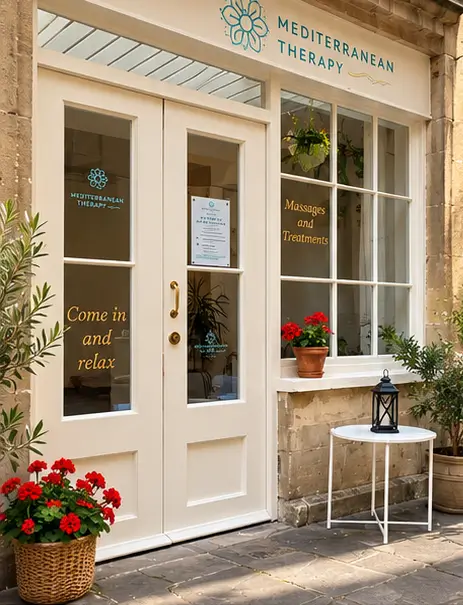
At Mediterranean Therapy in central Bath, a treatment plan is not a fixed subscription or a promise that everyone needs the same number of sessions. Your first appointment provides useful information: how the treatment feels, how long any benefit lasts and whether the approach suits your goal.

Book your professional Massage in Bath.

What determines how often you should have a massage?

A useful schedule considers several factors together:

    • •  your main goal relaxation, general wellbeing, recurring muscular tension or support around an active lifestyle
    • •  the type and intensity of the treatment
    • •  how you feel during the following 24 to 48 hours
    • •  how long the benefit appears to last
    • •  your health, medication, recent injury or medical care
    • •  your work, exercise, sleep and stress levels
    • •  your time and budget.

More frequent treatment is not automatically better. A schedule should have a clear purpose and should be reviewed rather than continued simply out of habit.

How often should you get a massage for relaxation?

For relaxation and general wellbeing, there is no medical requirement to follow a strict timetable. Some clients enjoy a massage once a month; others book only during particularly busy or stressful periods. The right interval is the one that feels valuable and sustainable.

If you notice that the calming effect lasts several weeks, a monthly appointment may suit you. If massage is an occasional treat, there is nothing wrong with booking less often. Regular sleep, movement, rest and stress-management habits remain important between appointments.

How often should you have massage for recurring tension?

When tension returns repeatedly, it may be reasonable to begin with appointments closer together and then increase the interval once symptoms feel more manageable. For example, a therapist and client might review progress after two or three sessions rather than committing in advance to a long package.

Research does not support one universal schedule. In one trial involving people with chronic neck pain, several 60-minute massages per week over four weeks produced better short-term outcomes than fewer or shorter sessions. That result applies to a specific research programme and does not mean that everyone with neck tension needs several massages each week.

Persistent or worsening pain should not be managed through massage alone. If pain lasts, affects normal movement, follows an injury or is accompanied by numbness, weakness, swelling, fever or feeling unwell, seek advice from a GP, physiotherapist or NHS 111 as appropriate.

How often should you get a Deep Tissue Massage?

Deep Tissue Massage should be timed according to the area treated, the pressure used and your response. If you feel comfortable afterwards, your next appointment can be guided by when the original tension begins to return. If you remain sore, the answer is not to repeat strong treatment immediately.

As explained in the second article in this series, mild tenderness may occur after focused work, but severe or worsening pain should not be dismissed as normal. Pressure, pace, technique or the time spent on one area can be adjusted at the next appointment.

Is a weekly massage too often?

A weekly massage is not necessarily too frequent for a healthy person when the treatment is appropriate and well tolerated. However, it should have a reason. A short weekly phase may suit someone reviewing a particular pattern of tension, while another person may gain everything they need from fortnightly or monthly care.

Frequent massage is not a substitute for diagnosis, rehabilitation or medical treatment. It should also not be used to repeatedly push through pain caused by training, work or an untreated injury.

When can you space appointments further apart?

Consider increasing the interval when:

    • •  the benefit lasts longer between appointments
    • •  daily movement and exercise feel comfortable
    • •  you can manage tension with ordinary self-care
    • •  your original goal has been reached
    • •  appointments are no longer producing a noticeable additional benefit

A good maintenance plan should support independence. The aim is not to make you feel that your body cannot cope without constant treatment.

How do you know when to book your next massage?

After each appointment, notice three things: how you feel later that day, how you feel over the next one or two days and how long any useful change remains noticeable. This gives more meaningful information than choosing an interval based only on a calendar.

You can also consider what is coming up. If you are planning heavy exercise, the third article in this series explains how to time massage around training and why there is no universal waiting period after treatment.

Frequently Asked Questions

One massage may be enough for relaxation or to decide whether the treatment suits you. A recurring concern may need review over more than one appointment, but no responsible therapist can guarantee a fixed number in advance.

A monthly massage can be a practical routine for relaxation or general wellbeing if you find it helpful. It is not a medical rule, and the benefit should be judged by your own experience and goals.

It may be possible, but repeating focused work on the same tender area may not be useful. Tell the therapist about the previous treatment and any soreness so the second session can be adapted or postponed.

Not necessarily. Some people prefer to book when familiar tension first begins to return. New, severe, unexplained or worsening symptoms, however, may need healthcare assessment rather than massage.

No. A short series can be useful when there is a clear goal and progress is reviewed, but you should understand why it is being suggested and remain free to change the plan.

Personalised Massage Therapy in Bath

At Mediterranean Therapy, every session begins with a conversation about your goals, comfort and relevant health information. Pressure is adjusted throughout the treatment, and your feedback helps shape future sessions.

Explore Deep Tissue Massage in Bath or Swedish Massage in Bath, or contact Mediterranean Therapy for help choosing a treatment and a realistic appointment schedule.

Visit Me for Your Massage in Bath

Enjoy your treatment at Mediterranean Therapy, located inside The Soul Spa a serene, centrally located wellness space in the heart of Bath:

📍 2 Hetling Court, Bath. Tel: 07378275075
👉 Click and get directions

Relax with a massage. Your expert massage therapist in Bath is ready to help you restore balance and calm, the best experience massage in Bath.

Teresa - Your Spa Therapist

Teresa - Your Spa Therapist

Massage therapist, facials and skincare with 5 star hotel experiences, an expert in a wide range of treatments.

Mediterranean Therapy
2 Hetling Court Bath - Tel: 07378275075

Massage Therapist Posts

Massage & Rejuvenation Services

  • Back, Neck & Shoulder
    Back, Neck & Shoulder

    30 mins – Click to Book!

    £ 35
  • Couple Massage
    Couple Massage

    1 hour – Click to Book!

    £ 140
  • Deep Tissue Massage
    Deep Tissue Massage

    1 hour – Click to Book!

    £ 70
  • Lymphatic Drainage Massage
    Lymphatic Drainage Massage

    1 hour – Click to Book!

    £ 70
  • Hot Stone Massage
    Hot Stone Massage

    1 hour – Click to Book!

    £ 70
  • Pregnancy Massage
    Pregnancy Massage

    1 hour – Click to Book!

    £ 70

Follow me on Social Media

Can You Exercise After a Massage? | Massage Therapy Bath

Can You Exercise After a Massage? | Massage Therapy Bath

Can You Exercise After a Massage? What to Do Before and After Treatment. Quick answer: Gentle movement after a massage is often comfortable, but an intense workout may be better postponed if you feel tender, unusually relaxed, light-headed or less stable than normal. There is no universal waiting time: consider the type of massage, the pressure used, how your body responds and what exercise you plan to do.

You may book a massage to support an active lifestyle, recover after training or ease tension before returning to the gym. A common question then follows: should you exercise before the massage, afterwards, or on a different day?

The answer is not simply “always wait 24 hours”. A gentle walk after a relaxing massage is very different from heavy squats after focused work on the hips and legs. At Mediterranean Therapy in Bath, aftercare is considered in relation to the individual treatment rather than one rule for everyone.

Book your professional Massage in Bath.

Can you work out immediately after a massage?

Sometimes, but it depends on how you feel and what the session involved. If the massage was gentle, you feel alert and comfortable, and the planned activity is light, you may not need to avoid movement.

An intense session is a different decision. Deep or concentrated work may leave an area temporarily tender, and a deeply relaxing treatment may make you feel less ready for heavy lifting, fast running or technically demanding exercise. Training through discomfort is unlikely to tell you anything useful about the quality of the massage.

How long should you wait after a Deep Tissue Massage?

There is no evidence-based waiting period that applies to every healthy person. As a practical approach, give yourself time to notice how the treated area responds. If you feel normal, comfortable movement may be reasonable. If you are sore, heavy or unusually fatigued, move the hard session to another day.

The direction of change matters. Mild tenderness should settle, not become progressively stronger. The previous article in this series explains what is usually temporary and when post-massage pain should not be dismissed as normal.

What movement is usually suitable after a massage?

For many people, low-intensity activity feels better than complete inactivity. Depending on your usual ability and health, this might include:

    • •  an easy walk
    • •  gentle everyday movement
    • •  comfortable mobility through a normal, pain-free range
    • •  slow breathing and relaxation
    • •  a gradual return to training once the body feels settled.

Avoid using aggressive stretching, heavy loading or a hard workout to “test” a tender area. Stop if movement produces sharp pain, worsening symptoms, dizziness, weakness or anything that feels unusual for you.

Is massage better before or after a workout?

The best timing depends on your purpose. Before exercise, a massage should not replace a proper sport-specific warm-up. Research does not show that massage reliably improves athletic performance, and longer pre-performance massage may be unhelpful for strength or sprint readiness.

After strenuous exercise, massage may help some people feel less sore and improve perceived recovery, but the research suggests that improvements in performance recovery are generally small or inconsistent. Massage can support a recovery routine; it is not a substitute for sleep, nutrition, gradual training and appropriate medical or physiotherapy care.

Can you exercise before a massage?

Yes, many people book after training. Allow your breathing and body temperature to return towards normal, drink according to thirst and arrive clean and comfortable. Tell the therapist what exercise you completed, which areas were heavily loaded and whether you noticed pain rather than ordinary fatigue.

If you have just sustained an injury, have significant swelling or bruising, or cannot use the area normally, massage should not be treated as a way to push through it. A GP, physiotherapist or NHS 111 may be more appropriate.

How should you plan massage around training?

If performance matters – for example, before a race, match or demanding gym session – arrange the massage at a time when you already know how your body tends to respond. Do not experiment with unfamiliar deep work immediately before an important event.

Tell your therapist about your training schedule and goal. Pressure, focus and treatment style can then be adapted. A Swedish Massage may suit a relaxation or rest day, while targeted Deep Tissue Massage may be planned when there is enough time to observe any temporary tenderness.

Frequently Asked Questions

Possibly. Light activity may be comfortable, but postpone heavy or intense training if you feel tender, tired, dizzy or less coordinated than normal.

An easy run may feel fine after a gentle treatment if you have no unusual symptoms. After focused work on the legs, hips or feet, it may be more sensible to wait until movement feels comfortable and normal.

A rest or lower-intensity day can make scheduling simpler, particularly for deeper work. It gives you time to notice your response without needing to complete a demanding session immediately afterwards.

Massage may reduce perceived soreness and support flexibility for some people, but improvements in performance recovery are usually modest. It should be one part of a broader recovery plan.

Personalised Massage Therapy in Bath

At Mediterranean Therapy, your treatment can be adapted around exercise, work demands and how your body feels on the day. The aim is not to follow the strongest routine, but to choose pressure and timing that support your goal safely and comfortably.

Explore Deep Tissue Massage in Bath, Swedish Massage in Bath or book an appointment for personalised guidance.

Visit Me for Your Massage in Bath

Enjoy your treatment at Mediterranean Therapy, located inside The Soul Spa a serene, centrally located wellness space in the heart of Bath:

📍 2 Hetling Court, Bath. Tel: 07378275075
👉 Click and get directions

Relax with a massage. Your expert massage therapist in Bath is ready to help you restore balance and calm, the best experience massage in Bath.

Teresa - Your Spa Therapist

Teresa - Your Spa Therapist

Massage therapist, facials and skincare with 5 star hotel experiences, an expert in a wide range of treatments.

Mediterranean Therapy
2 Hetling Court Bath - Tel: 07378275075

Massage Therapist Posts

Massage & Rejuvenation Services

  • Back, Neck & Shoulder
    Back, Neck & Shoulder

    30 mins – Click to Book!

    £ 35
  • Couple Massage
    Couple Massage

    1 hour – Click to Book!

    £ 140
  • Deep Tissue Massage
    Deep Tissue Massage

    1 hour – Click to Book!

    £ 70
  • Lymphatic Drainage Massage
    Lymphatic Drainage Massage

    1 hour – Click to Book!

    £ 70
  • Hot Stone Massage
    Hot Stone Massage

    1 hour – Click to Book!

    £ 70
  • Pregnancy Massage
    Pregnancy Massage

    1 hour – Click to Book!

    £ 70

Follow me on Social Media

Why Am I Sore After a Massage? | Massage Therapy Bath

Why Am I Sore After a Massage? | Massage Therapy Bath

Why Do I Feel Sore After a Massage? What Is Normal and When to Seek Advice. Quick answer: Mild tenderness after a massage can happen, particularly after focused or unfamiliar pressure. It should usually feel manageable and begin to ease within a day or two. Severe, sharp or worsening pain, marked swelling or bruising, numbness, weakness or feeling unwell is not something to dismiss as normal massage soreness.

You leave your massage feeling looser and more relaxed. Later that evening, or the following morning, an area feels tender – almost as though you have exercised. It is understandable to wonder whether this is normal and whether the treatment was too strong.

Some people experience short-lived soreness after massage, while others feel none at all. Neither response proves how effective the treatment was. At Mediterranean Therapy in Bath, pressure and technique are adapted to the individual, because a useful treatment should never be measured by how sore you feel afterwards.

Book your professional Massage in Bath.

Why can you feel sore after a massage?

Massage places mechanical pressure on skin, muscles and other soft tissues. An area that was already sensitive, tense or recently overloaded may respond with temporary tenderness, especially when it receives more focused work than it is used to.

Your response may also vary according to the pressure used, how long one area was treated, your recent activity, sleep, stress, general health and sensitivity on that particular day. The exact reason cannot always be reduced to one simple mechanism.

Importantly, soreness is not evidence that “toxins” or lactic acid have been released. Those popular explanations are misleading. Post-massage tenderness is better understood as an individual, short-term response to touch and pressure.

Is it normal to be sore after a Deep Tissue Massage?

A little localised tenderness can occur after Deep Tissue Massage, particularly if the session included slow, concentrated work on an already sensitive area. It should remain mild, should not interfere significantly with normal movement and should gradually improve rather than intensify.

Deep tissue does not have to mean maximum pressure. As explained in the first article in this series, a massage does not need to hurt to be effective. More discomfort during or after treatment is not proof of a better result.

How long should massage soreness last?

Minor after-effects often begin within several hours and settle within approximately 24 to 48 hours. A study of massage clients found that most minor negative symptoms began within 12 hours and lasted 36 hours or less, although every person and treatment is different.

The important feature is the direction of change: mild tenderness should be easing. If pain is becoming stronger, lasts beyond a couple of days without improvement or affects your ability to move normally, contact the therapist and consider advice from a GP, physiotherapist or NHS 111.

What can help after a massage?

Aftercare does not need to be complicated. If you feel mildly tender:

    1. keep the rest of the day relatively gentle and avoid immediately testing the area with intense exercise
    2. continue comfortable everyday movement rather than remaining completely still
    3. use a warm shower or other gentle warmth if it feels soothing and is appropriate for you
    4. drink normally according to thirst; extra water is not required to “flush out toxins”
    5. notice whether the sensation is improving and tell your therapist before your next treatment.

If you have a health condition, recent injury or surgery, or you take medication that affects bleeding or sensation, follow the advice of your healthcare professional rather than generic aftercare.

When is pain after massage not normal?

Massage is generally low risk for many people, but vigorous treatment is not appropriate in every circumstance. Do not assume that every new symptom is simply part of the process.

Seek medical advice if you experience:

    • •  severe, sharp or rapidly worsening pain
    • •  significant or increasing swelling or bruising
    • •  new numbness, tingling, weakness or loss of normal movement
    • •  pain accompanied by fever or feeling generally unwell
    • •  symptoms that persist without improvement.

NHS 111 can advise when urgent assessment may be needed. Call 999 for emergency symptoms such as chest pain, severe breathing difficulty or sudden signs of a stroke.

How can post-massage soreness be reduced next time?

Tell your therapist how you felt after the previous session. Useful feedback includes where you felt sore, how intense it was and how long it lasted. The next treatment can then be adjusted through pressure, pace, positioning, technique or the amount of time spent on one area.

You can also speak up during the massage. If you begin holding your breath, bracing or pulling away, the pressure may no longer be useful. A Swedish Massage or a more moderate approach may sometimes suit your goal better than concentrated deep work.

Frequently Asked Questions

No. You may benefit from a treatment without feeling sore afterwards. Soreness is a possible response, not a measure of quality or effectiveness.

Comfortable everyday movement is generally reasonable, but it may be sensible to postpone intense exercise if the treated area feels tender. If symptoms are unusual or significant, seek individual advice.

Stay normally hydrated and drink according to thirst. Water supports general wellbeing, but there is no need to force large amounts to remove supposed toxins released by massage.

Yes, occasionally. Sensitivity depends on the person, the area treated and their circumstances that day, not only on whether the pressure felt firm.

Personalised Massage Therapy in Bath

At Mediterranean Therapy, every session begins with a conversation about your goals, comfort and relevant health information. Pressure is adjusted throughout the treatment, and your feedback helps shape future sessions.

If you are unsure which approach would suit you, explore Deep Tissue Massage in Bath or Swedish Massage in Bath, or contact Mediterranean Therapy for guidance before booking.

Visit Me for Your Massage in Bath

Enjoy your treatment at Mediterranean Therapy, located inside The Soul Spa a serene, centrally located wellness space in the heart of Bath:

📍 2 Hetling Court, Bath. Tel: 07378275075
👉 Click and get directions

Relax with a massage. Your expert massage therapist in Bath is ready to help you restore balance and calm, the best experience massage in Bath.

Teresa - Your Spa Therapist

Teresa - Your Spa Therapist

Massage therapist, facials and skincare with 5 star hotel experiences, an expert in a wide range of treatments.

Mediterranean Therapy
2 Hetling Court Bath - Tel: 07378275075

Massage Therapist Posts

Massage & Rejuvenation Services

  • Back, Neck & Shoulder
    Back, Neck & Shoulder

    30 mins – Click to Book!

    £ 35
  • Couple Massage
    Couple Massage

    1 hour – Click to Book!

    £ 140
  • Deep Tissue Massage
    Deep Tissue Massage

    1 hour – Click to Book!

    £ 70
  • Lymphatic Drainage Massage
    Lymphatic Drainage Massage

    1 hour – Click to Book!

    £ 70
  • Hot Stone Massage
    Hot Stone Massage

    1 hour – Click to Book!

    £ 70
  • Pregnancy Massage
    Pregnancy Massage

    1 hour – Click to Book!

    £ 70

Follow me on Social Media

Should a Massage Hurt to Be Effective? | Deep Tissue Massage Bath

Should a Massage Hurt to Be Effective? | Deep Tissue Massage Bath

Should a Massage Hurt to Be Effective? Understanding Pressure, Pain and Communication. Quick answer: No. A massage does not need to hurt to be effective. Firm pressure may feel intense or tender in a tight area, but it should remain manageable and should not cause sharp, burning, electrical or overwhelming pain. The right pressure is the level that supports your goal while allowing your body to feel safe and your muscles to remain responsive.

Many people arrive for a Deep Tissue Massage believing that the treatment must be painful to work. They may think that staying silent through strong pressure is part of the process, or that soreness afterwards proves that something has been released.

In reality, deeper is not automatically better. Pressure is only one part of massage, alongside pace, positioning, technique, timing and communication. At Mediterranean Therapy in Bath, treatment is adapted to the individual rather than delivered at one fixed intensity.

Book your professional Massage in Bath.

Why do some massages feel intense?

Areas that already feel tense or sensitive can respond differently to touch. Focused work around a tight muscle may create a strong sensation, particularly if the area has been overloaded by repetitive activity, exercise, posture or stress.

Some clients describe this as a productive tenderness: they can feel the area being worked, but they can still breathe normally, stay relaxed and communicate. That is different from pain that makes the body brace, pull away or hold its breath.

What is the difference between pressure and pain?

There is no universal pressure scale that feels the same to everyone. A level that feels comfortable to one person may be excessive for another, and your tolerance can change from one day to the next.

Strong but manageable sensations may include:

    • •  steady pressure that feels focused on a tense area
    • •  temporary tenderness that eases when the technique changes
    • •  a sensation that remains within your control
    • •  pressure during which you can continue breathing and relaxing.

Ask for the pressure to be reduced or stopped if you experience:

    • •  sharp, stabbing or burning pain
    • •  tingling, numbness or an electrical sensation
    • •  pain that travels unexpectedly into another area
    • •  pressure that makes you tense, hold your breath or want to move away
    • •  any sensation that feels frightening, unsafe or simply wrong.

Does Deep Tissue Massage have to hurt?

No. Deep Tissue Massage refers to focused work with deeper muscular and connective-tissue layers; it does not mean using the maximum pressure a therapist can deliver. Slow techniques, sustained contact and careful positioning may allow effective work without forcing the body.

If pressure is too strong, you may instinctively tighten the very area that the therapist is trying to work with. A treatment can therefore be intense without becoming a test of endurance. The aim is not to win a battle against the muscle, but to work progressively within a level that is appropriate for you.

Can a lighter massage still be effective?

Yes. The most appropriate treatment depends on why you booked. A lighter or moderate-pressure massage may be a better choice when the priority is relaxation, when you are highly sensitive, or when deeper work would not be suitable.

A Swedish or relaxation-style massage uses flowing, rhythmical movements and can help the body settle without strong pressure. Gentle does not mean ineffective, just as firm does not automatically mean therapeutic. A professional consultation helps match the approach to your goals and health circumstances.

Why communication matters during massage

Your therapist can observe changes in breathing or muscle tension, but cannot feel exactly what you feel. Clear feedback is therefore part of a good treatment, not an interruption or a complaint.

You can say:

    • •  ‘Could you use a little less pressure there?’
    • •  ‘That feels strong but comfortable.’
    • •  ‘I am feeling tingling; can we stop and change position?’
    • •  ‘Could we spend less time on this area?’
    • •  ‘I would prefer a gentler treatment today.’

You are also free to change your mind. Agreeing to firm pressure at the beginning does not mean you must continue with it throughout the session.

Can too much massage pressure be harmful?

Massage is generally considered low risk for many healthy people, but it is not risk-free for everyone. Very vigorous techniques may be inappropriate in certain circumstances, and rare serious adverse effects have been reported, particularly where a person already had an increased risk of injury.

Tell your therapist about relevant health conditions, recent surgery or injury, pregnancy, medication, unexplained swelling, skin problems or unusual pain. Treatment may need to be adapted, postponed or referred for medical assessment. Massage should not be used to push through symptoms that need diagnosis.

Is soreness after a deep massage normal?

Some people notice mild, short-lived tenderness after focused work, while others feel no soreness at all. More soreness does not prove that a massage was more successful. Pain that is severe, worsening, associated with swelling or neurological symptoms, or does not settle should not simply be dismissed as normal aftercare.

The next article in this series will explore this question in more detail: Why Do I Feel Sore After a Massage?

Frequently Asked Questions

No. Massage may sometimes feel strong or tender, but it should not feel sharp, burning, unbearable or unsafe. Tell the therapist whenever a sensation is not right for you.

People sometimes use this phrase for strong but manageable tenderness that feels relevant to a tight area. It is not a medical category and should never be used to persuade you to tolerate pain.

The pressure may be too intense, the position may be uncomfortable, or you may not feel fully at ease. Tell the therapist so that pressure, pace, position or technique can be changed.

At Mediterranean Therapy, pressure is discussed and adjusted throughout the treatment. Whether you choose Deep Tissue Massage or a more relaxing approach, the session should reflect your comfort, goals and response on that particular day.

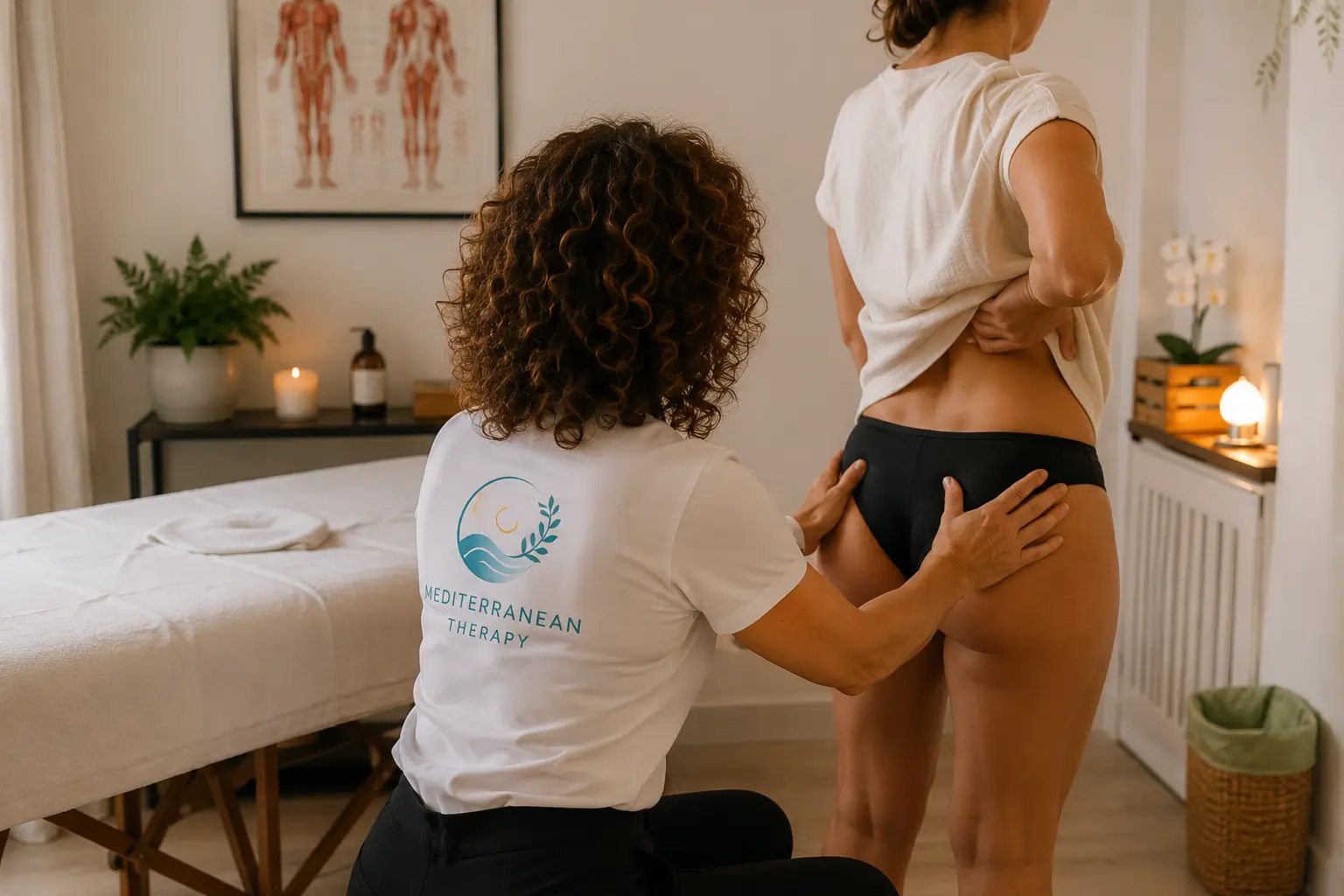
If you’re experiencing muscular tightness around your lower back, hips or glutes and are looking for a deep tissue massage or therapeutic massage in Bath, treatment can be adapted to your individual needs rather than following a standard routine.

Mediterranean Therapy offers personalised massage treatments in central Bath, including Deep Tissue Massage, therapeutic massage and Manual Lymphatic Drainage, with each treatment selected according to the client’s goals and suitability.

If you’re unsure which massage to book, simply get in touch and explain what you’re experiencing before your appointment.

Visit Me for Your Massage in Bath

Enjoy your treatment at Mediterranean Therapy, located inside The Soul Spa a serene, centrally located wellness space in the heart of Bath:

📍 2 Hetling Court, Bath. Tel: 07378275075
👉 Click and get directions

Relax with a massage. Your expert massage therapist in Bath is ready to help you restore balance and calm, the best experience massage in Bath.

Teresa - Your Spa Therapist

Teresa - Your Spa Therapist

Massage therapist, facials and skincare with 5 star hotel experiences, an expert in a wide range of treatments.

Mediterranean Therapy
2 Hetling Court Bath - Tel: 07378275075

Massage Therapist Posts

Massage & Rejuvenation Services

  • Back, Neck & Shoulder
    Back, Neck & Shoulder

    30 mins – Click to Book!

    £ 35
  • Couple Massage
    Couple Massage

    1 hour – Click to Book!

    £ 140
  • Deep Tissue Massage
    Deep Tissue Massage

    1 hour – Click to Book!

    £ 70
  • Lymphatic Drainage Massage
    Lymphatic Drainage Massage

    1 hour – Click to Book!

    £ 70
  • Hot Stone Massage
    Hot Stone Massage

    1 hour – Click to Book!

    £ 70
  • Pregnancy Massage
    Pregnancy Massage

    1 hour – Click to Book!

    £ 70

Follow me on Social Media

Tight Hips & Hip Flexors | Deep Tissue Massage Bath

Tight Hips & Hip Flexors | Deep Tissue Massage Bath

Why Sitting All Day May Leave Your Hips Feeling Stiff. You stand up after several hours at your desk and immediately notice it.

Your hips feel stiff.

Perhaps you need a few steps before you feel as though you’re moving normally again.

There may be a pulling sensation at the front of the hip, tension around the glutes or an uncomfortable feeling that seems to connect your hips and lower back.

You search online and quickly find the usual explanation:

“Your hip flexors are tight because you sit too much.”

And then comes the usual solution:

“Stretch your hip flexors.”

It sounds straightforward.

But, as is often the case with the human body, the reality is more interesting.

Feeling tight doesn’t necessarily mean that a muscle has physically become permanently shortened.

And hip stiffness doesn’t automatically mean that the hip flexors are the problem.

The hips are influenced by movement, muscles, joints, activity levels, workload and the way the lower back, pelvis and legs work together.

So let’s look at what might actually be happening.

Book your professional Massage in Bath.

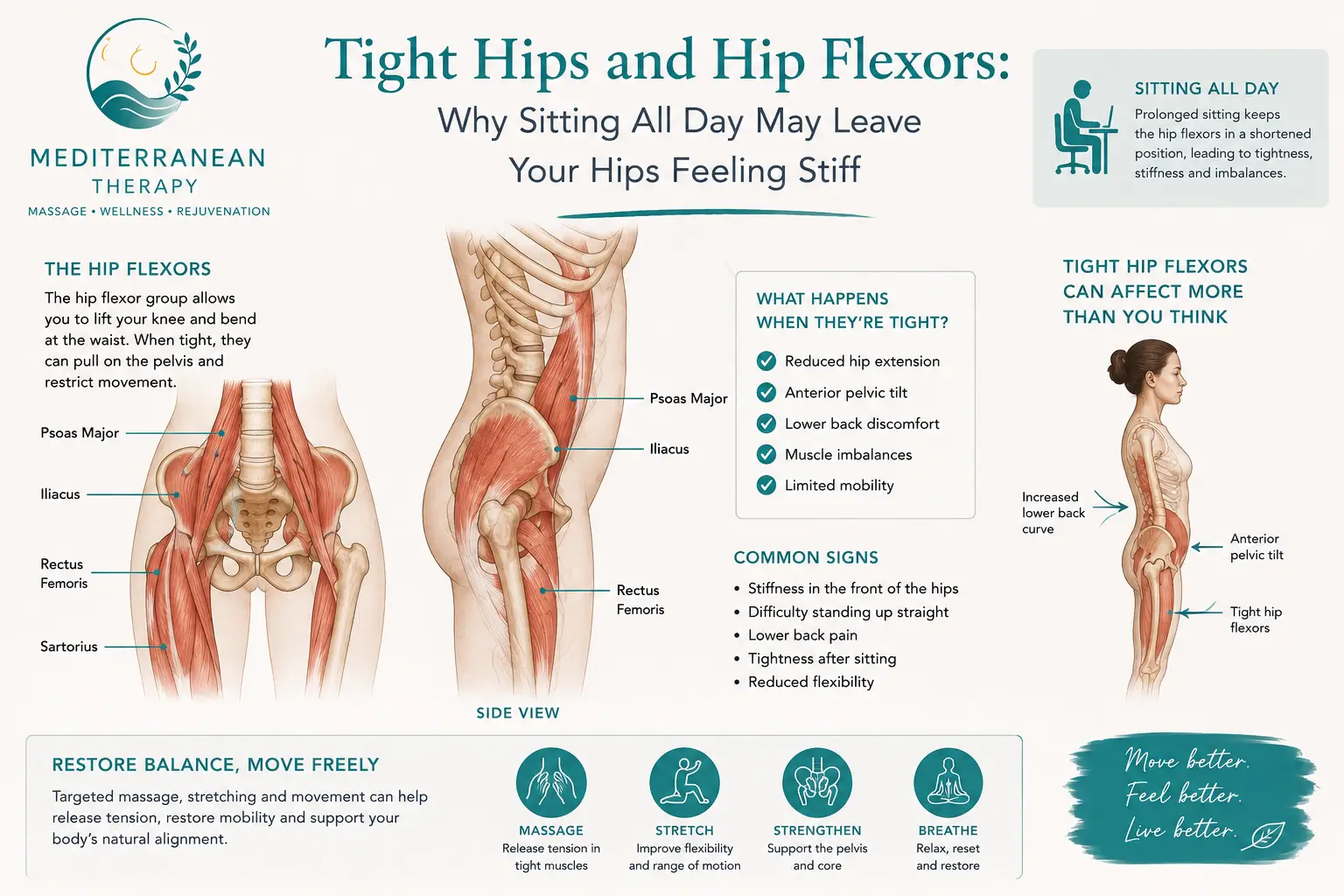
What Are the Hip Flexors?

The hip flexors are a group of muscles involved in bringing your thigh towards your body the movement you make when lifting your knee towards your chest.

One of the best-known is the iliopsoas.

The iliopsoas includes the psoas major and iliacus, which join before attaching to the upper femur.

The psoas is particularly interesting because it originates from the lumbar region of the spine, while the iliacus originates from the inside of the pelvis.

Together, they play an important role in hip flexion and also contribute to stability around the hip and lumbar region.

But they don’t work alone.

Movement around the hip also involves the:

•  gluteal muscles
•  adductors
•  hamstrings
•  quadriceps
•  deeper hip rotators
•  abdominal and trunk muscles

This is why thinking of hip tightness as simply “one short muscle that needs stretching” can be an oversimplification.

Why Do My Hips Feel Tight After Sitting?

When you’re sitting, your hips remain in a flexed position.

If you stay there for a long time and then suddenly stand, it’s perfectly understandable that the first few movements may feel stiff.

Think about keeping your hand in one position for hours.

When you finally move it, it may feel temporarily stiff.

That doesn’t necessarily mean anything is damaged or permanently shortened.

The same principle can apply to the hips.

The sensation may reflect a combination of:

•  prolonged lack of movement
•  muscular fatigue
•  sensitivity
•  changes in load
•  reduced movement variety
•  general stiffness after remaining in one position

For many people, the key issue isn’t simply sitting.

It’s not moving for a long time.

Does Sitting Actually Make Your Hip Flexors Short?

This is where internet explanations can become misleading.

You’ll often see diagrams claiming that sitting causes the hip flexors to become permanently shortened and that this then pulls the pelvis forward, switches off the glutes and causes lower-back pain.

The body isn’t quite that simple.

Muscles adapt to how they’re used, but the sensation of tightness isn’t a direct measurement of muscle length.

A muscle can feel tight without actually being anatomically short.

This distinction matters because otherwise people can spend months aggressively stretching a muscle simply because it feels tight.

Sometimes stretching feels wonderful.

Sometimes movement or strengthening may be more useful.

And sometimes the sensation isn’t primarily coming from the muscle you think it is.

Tightness Is a Feeling, Not a Diagnosis

This is an important concept.

When someone tells me:

“My hips are really tight.”

I know what they mean.

But “tight hips” isn’t a medical diagnosis.

One person may mean:

“I feel stiff when I stand after working at my computer.”

Another might mean:

“I can’t comfortably cross my legs.”

Someone else means:

“I have a pulling sensation in the front of my hip when I walk.”

And another person may actually have significant joint pain.

Those situations aren’t necessarily the same.

Before assuming the hip flexors simply need to be released, it’s useful to understand what the person actually experiences.

The Hip–Glute–Lower Back Connection

The hip doesn’t function in isolation.

The pelvis sits between the spine and legs, creating an important connection between the lower body and trunk.

When you:

•  walk
•  climb stairs
•  squat
•  run
•  bend
•  stand up from a chair

multiple areas coordinate the movement.

This includes the hips, glutes, lower back and abdominal muscles.

That’s why someone who complains of “tight hips” may also report:

•  gluteal tension
•  lower-back stiffness
•  tight thighs
•  discomfort after sitting
•  difficulty getting comfortable after •  driving
•  stiffness after exercise

It doesn’t mean one muscle is necessarily causing all of these symptoms.

It means the areas are functionally connected.

What About the Glutes?

The gluteal muscles are powerful muscles involved in hip movement and stability.

They are particularly important during walking, running, climbing and standing up.

You may have heard the expression:

“Sitting switches off your glutes.”

Again, that’s an oversimplification.

Your glutes don’t literally stop functioning because you work at a desk.

However, spending large parts of the day relatively inactive means they aren’t being challenged in the same way as when you’re walking, climbing stairs or exercising.

This is another reason why movement variety and appropriate strengthening can be valuable.

The solution to every tight hip isn’t necessarily more stretching.

Can Tight Hips Affect the Lower Back?

People frequently experience hip and lower-back stiffness together.

This makes sense because of the anatomical and functional relationship between these areas.

The psoas, for example, has attachments to the lumbar spine and plays roles involving both hip movement and lumbar stability.

However, that doesn’t mean:

“Your tight psoas is causing your back pain.”

Back pain has many potential contributors and is rarely explained by one muscle alone.

What we can say is that the lower back, pelvis and hips work together, and muscular tension across these regions can sometimes coexist.

This is why a massage treatment for someone complaining of tight hips may involve looking at more than the front of the hip.

Who Commonly Experiences Tight Hips?

Desk workers

This is probably the most obvious group.

Long periods sitting at a computer can leave people feeling stiff through the hips, lower back and shoulders.

Regular movement breaks may be more useful than obsessing over achieving a perfect sitting posture.

Drivers

Long journeys can create a similar experience.

You remain in one position with relatively little opportunity to change the angle of your hips.

Many people notice stiffness when first getting out of the car.

Runners

Running repeatedly loads the muscles around the hip.

Glutes, hip flexors, hamstrings and other muscles all contribute to movement and stability.

A sudden increase in distance or training intensity can sometimes be followed by muscular soreness or tension.

Cyclists

Cycling involves repeated hip flexion and a relatively fixed riding position.

Some cyclists therefore notice stiffness around the hips or lower back, particularly after longer rides.

Gym users

Squats, lunges, deadlifts and other exercises place substantial demands on the hips.

Muscular soreness following training can be perfectly normal, although persistent or sharp pain deserves appropriate attention.

People who simply don’t move very much

You don’t need to be an athlete to experience muscular stiffness.

Modern life often involves moving between:

bed → car → desk → car → sofa.

The body generally benefits from movement variety.

Hip Flexor Pain vs Hip Flexor Tightness

These terms shouldn’t automatically be used interchangeably.

A feeling of tightness may simply be stiffness or muscular tension.

Pain can have many potential causes.

Hip pain may be associated with:

muscle or tendon irritation
bursitis
osteoarthritis
injury
joint-related problems
referred symptoms from another region
other musculoskeletal conditions.
A massage therapist shouldn’t diagnose these conditions.

If somebody describes genuine hip pain rather than ordinary muscular tightness, the first question shouldn’t automatically be:

“How deeply should I massage the psoas?”

Sometimes assessment by a GP or physiotherapist is more appropriate.

Should You Stretch Tight Hip Flexors?

Stretching can feel pleasant and may temporarily improve how mobile you feel.

But you don’t necessarily need to spend twenty minutes aggressively stretching your hip flexors every day.

Try thinking more broadly.

Instead of:

“How do I stretch this tight muscle?”

consider:

“How can I give my hips more movement variety?”

That might include:

•  getting up regularly
•  walking
•  changing sitting positions
•  gentle mobility
•  appropriate strength •  training
•  returning gradually to activity

Different people need different things.

Can Massage Help Tight Hips?

Massage may be useful for associated muscular tension, soreness and stiffness around the hips, glutes and lower back.

Depending on the individual, treatment might involve muscles around the:

•  gluteal region
•  lateral hip
•  lower back
•  thighs
•  hip flexor region
•  surrounding soft tissues

But massage isn’t about “putting the hip back into place” or permanently lengthening a supposedly shortened muscle.

A more realistic aim is to help reduce muscular tension, provide a comfortable change in sensation and support easier movement.

Deep Tissue Massage for Tight Hips

People searching for deep tissue massage in Bath often want help with persistent muscular tightness.

Deep tissue massage may be useful when somebody experiences tension around the glutes, hips or lower back.

But, as I’ve discussed in previous articles, deep tissue doesn’t simply mean maximum pressure.

The hip region contains important nerves, blood vessels and other sensitive structures.

Some deeper muscles are also not suitable for aggressive pressure.

Treatment should therefore be targeted and adapted rather than simply “digging deeper”.

Sometimes broad, slower pressure is appropriate.

Sometimes focused work around the glutes is useful.

Sometimes working on surrounding areas provides a better experience than repeatedly pressing the place that feels tight.

Frequently Asked Questions

Remaining in one position for a long time can leave the hips feeling temporarily stiff. This doesn’t necessarily mean your hip flexors have permanently shortened.

Prolonged sitting can contribute to a feeling of hip stiffness, but “tightness” is a sensation and doesn’t automatically prove that a muscle is anatomically short.

Several muscles contribute to hip flexion. The iliopsoas principally the psoas major and iliacus is particularly important.

Hip and lower-back symptoms can coexist because these regions work closely together, but it is usually too simplistic to say that one tight muscle is automatically causing back pain.

Massage may help with associated muscular tension and stiffness when appropriate. Treatment may also involve surrounding areas such as the glutes, thighs and lower back.

Deep Tissue Massage can be appropriate for muscular tension around the hips and glutes, but deeper isn’t always better. Pressure should be adapted to the individual and the area being treated.

No. Sports massage techniques may also be relevant to people experiencing muscular tension from work, prolonged sitting or everyday repetitive activity.

Not necessarily. The psoas is a deep muscle and direct work isn’t automatically required simply because your hips feel tight.

Not everyone needs the same stretching routine. Movement variety, walking, mobility and appropriate strengthening may also be useful.

Manual Lymphatic Drainage has a different purpose and isn’t used to treat tight hip flexors. If your main concern is muscular stiffness, a therapeutic or Deep Tissue Massage may be more relevant, depending on your individual circumstances.

If you’re experiencing muscular tightness around your lower back, hips or glutes and are looking for a deep tissue massage or therapeutic massage in Bath, treatment can be adapted to your individual needs rather than following a standard routine.

Mediterranean Therapy offers personalised massage treatments in central Bath, including Deep Tissue Massage, therapeutic massage and Manual Lymphatic Drainage, with each treatment selected according to the client’s goals and suitability.

If you’re unsure which massage to book, simply get in touch and explain what you’re experiencing before your appointment.

Visit Me for Your Massage in Bath

Enjoy your treatment at Mediterranean Therapy, located inside The Soul Spa a serene, centrally located wellness space in the heart of Bath:

📍 2 Hetling Court, Bath. Tel: 07378275075
👉 Click and get directions

Relax with a massage. Your expert massage therapist in Bath is ready to help you restore balance and calm, the best experience massage in Bath.

Teresa - Your Spa Therapist

Teresa - Your Spa Therapist

Massage therapist, facials and skincare with 5 star hotel experiences, an expert in a wide range of treatments.

Mediterranean Therapy
2 Hetling Court Bath - Tel: 07378275075

Massage Therapist Posts

Massage & Rejuvenation Services

  • Back, Neck & Shoulder
    Back, Neck & Shoulder

    30 mins – Click to Book!

    £ 35
  • Couple Massage
    Couple Massage

    1 hour – Click to Book!

    £ 140
  • Deep Tissue Massage
    Deep Tissue Massage

    1 hour – Click to Book!

    £ 70
  • Lymphatic Drainage Massage
    Lymphatic Drainage Massage

    1 hour – Click to Book!

    £ 70
  • Hot Stone Massage
    Hot Stone Massage

    1 hour – Click to Book!

    £ 70
  • Pregnancy Massage
    Pregnancy Massage

    1 hour – Click to Book!

    £ 70

Follow me on Social Media