Tight Hips & Hip Flexors | Deep Tissue Massage Bath

Why Sitting All Day May Leave Your Hips Feeling Stiff. You stand up after several hours at your desk and immediately notice it.

Your hips feel stiff.

Perhaps you need a few steps before you feel as though you’re moving normally again.

There may be a pulling sensation at the front of the hip, tension around the glutes or an uncomfortable feeling that seems to connect your hips and lower back.

You search online and quickly find the usual explanation:

“Your hip flexors are tight because you sit too much.”

And then comes the usual solution:

“Stretch your hip flexors.”

It sounds straightforward.

But, as is often the case with the human body, the reality is more interesting.

Feeling tight doesn’t necessarily mean that a muscle has physically become permanently shortened.

And hip stiffness doesn’t automatically mean that the hip flexors are the problem.

The hips are influenced by movement, muscles, joints, activity levels, workload and the way the lower back, pelvis and legs work together.

So let’s look at what might actually be happening.

Book your professional Massage in Bath.

What Are the Hip Flexors?

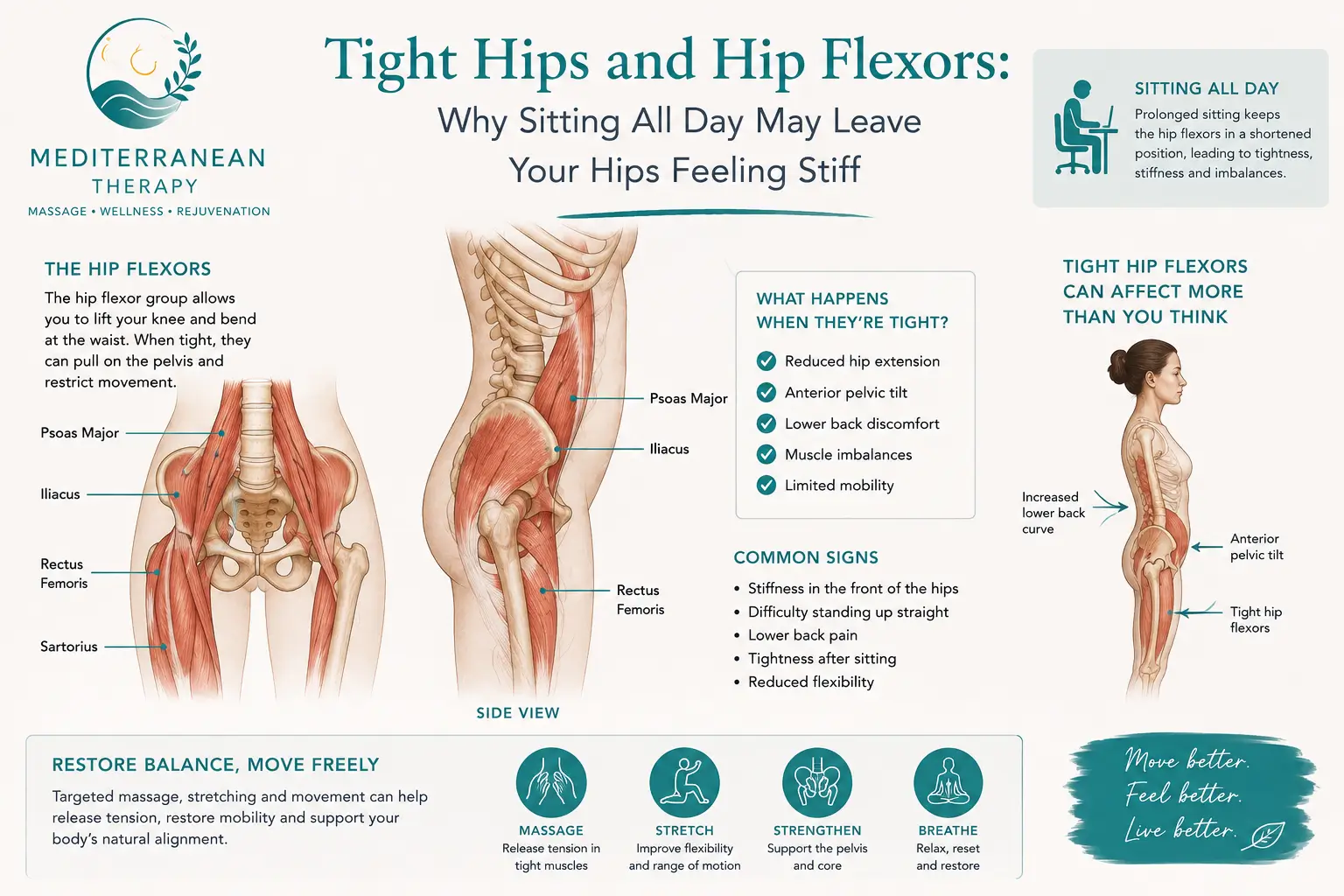
The hip flexors are a group of muscles involved in bringing your thigh towards your body the movement you make when lifting your knee towards your chest.

One of the best-known is the iliopsoas.

The iliopsoas includes the psoas major and iliacus, which join before attaching to the upper femur.

The psoas is particularly interesting because it originates from the lumbar region of the spine, while the iliacus originates from the inside of the pelvis.

Together, they play an important role in hip flexion and also contribute to stability around the hip and lumbar region.

But they don’t work alone.

Movement around the hip also involves the:

•  gluteal muscles
•  adductors
•  hamstrings
•  quadriceps
•  deeper hip rotators
•  abdominal and trunk muscles

This is why thinking of hip tightness as simply “one short muscle that needs stretching” can be an oversimplification.

Why Do My Hips Feel Tight After Sitting?

When you’re sitting, your hips remain in a flexed position.

If you stay there for a long time and then suddenly stand, it’s perfectly understandable that the first few movements may feel stiff.

Think about keeping your hand in one position for hours.

When you finally move it, it may feel temporarily stiff.

That doesn’t necessarily mean anything is damaged or permanently shortened.

The same principle can apply to the hips.

The sensation may reflect a combination of:

•  prolonged lack of movement
•  muscular fatigue
•  sensitivity
•  changes in load
•  reduced movement variety
•  general stiffness after remaining in one position

For many people, the key issue isn’t simply sitting.

It’s not moving for a long time.

Does Sitting Actually Make Your Hip Flexors Short?

This is where internet explanations can become misleading.

You’ll often see diagrams claiming that sitting causes the hip flexors to become permanently shortened and that this then pulls the pelvis forward, switches off the glutes and causes lower-back pain.

The body isn’t quite that simple.

Muscles adapt to how they’re used, but the sensation of tightness isn’t a direct measurement of muscle length.

A muscle can feel tight without actually being anatomically short.

This distinction matters because otherwise people can spend months aggressively stretching a muscle simply because it feels tight.

Sometimes stretching feels wonderful.

Sometimes movement or strengthening may be more useful.

And sometimes the sensation isn’t primarily coming from the muscle you think it is.

Tightness Is a Feeling, Not a Diagnosis

This is an important concept.

When someone tells me:

“My hips are really tight.”

I know what they mean.

But “tight hips” isn’t a medical diagnosis.

One person may mean:

“I feel stiff when I stand after working at my computer.”

Another might mean:

“I can’t comfortably cross my legs.”

Someone else means:

“I have a pulling sensation in the front of my hip when I walk.”

And another person may actually have significant joint pain.

Those situations aren’t necessarily the same.

Before assuming the hip flexors simply need to be released, it’s useful to understand what the person actually experiences.

The Hip–Glute–Lower Back Connection

The hip doesn’t function in isolation.

The pelvis sits between the spine and legs, creating an important connection between the lower body and trunk.

When you:

•  walk
•  climb stairs
•  squat
•  run
•  bend
•  stand up from a chair

multiple areas coordinate the movement.

This includes the hips, glutes, lower back and abdominal muscles.

That’s why someone who complains of “tight hips” may also report:

•  gluteal tension
•  lower-back stiffness
•  tight thighs
•  discomfort after sitting
•  difficulty getting comfortable after •  driving
•  stiffness after exercise

It doesn’t mean one muscle is necessarily causing all of these symptoms.

It means the areas are functionally connected.

What About the Glutes?

The gluteal muscles are powerful muscles involved in hip movement and stability.

They are particularly important during walking, running, climbing and standing up.

You may have heard the expression:

“Sitting switches off your glutes.”

Again, that’s an oversimplification.

Your glutes don’t literally stop functioning because you work at a desk.

However, spending large parts of the day relatively inactive means they aren’t being challenged in the same way as when you’re walking, climbing stairs or exercising.

This is another reason why movement variety and appropriate strengthening can be valuable.

The solution to every tight hip isn’t necessarily more stretching.

Can Tight Hips Affect the Lower Back?

People frequently experience hip and lower-back stiffness together.

This makes sense because of the anatomical and functional relationship between these areas.

The psoas, for example, has attachments to the lumbar spine and plays roles involving both hip movement and lumbar stability.

However, that doesn’t mean:

“Your tight psoas is causing your back pain.”

Back pain has many potential contributors and is rarely explained by one muscle alone.

What we can say is that the lower back, pelvis and hips work together, and muscular tension across these regions can sometimes coexist.

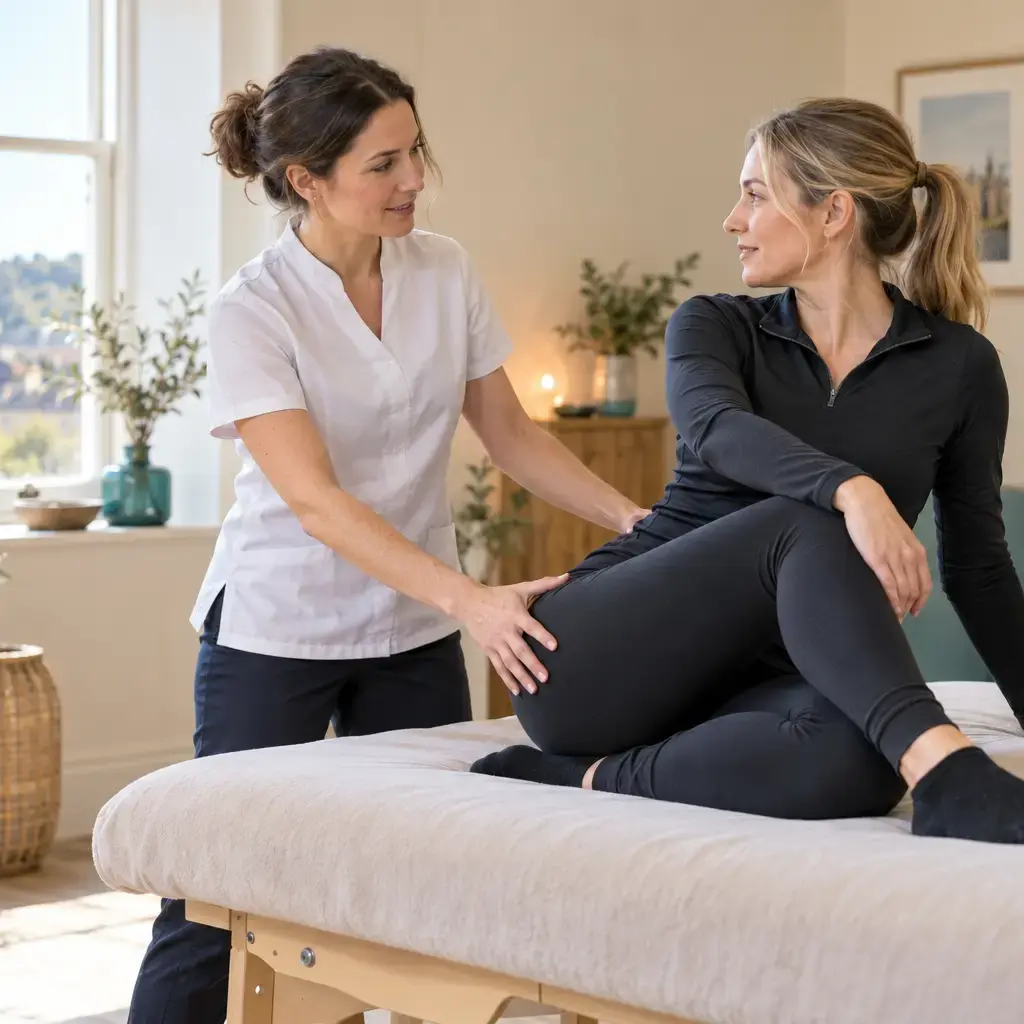
This is why a massage treatment for someone complaining of tight hips may involve looking at more than the front of the hip.

Who Commonly Experiences Tight Hips?

Desk workers

This is probably the most obvious group.

Long periods sitting at a computer can leave people feeling stiff through the hips, lower back and shoulders.

Regular movement breaks may be more useful than obsessing over achieving a perfect sitting posture.

Drivers

Long journeys can create a similar experience.

You remain in one position with relatively little opportunity to change the angle of your hips.

Many people notice stiffness when first getting out of the car.

Runners

Running repeatedly loads the muscles around the hip.

Glutes, hip flexors, hamstrings and other muscles all contribute to movement and stability.

A sudden increase in distance or training intensity can sometimes be followed by muscular soreness or tension.

Cyclists

Cycling involves repeated hip flexion and a relatively fixed riding position.

Some cyclists therefore notice stiffness around the hips or lower back, particularly after longer rides.

Gym users

Squats, lunges, deadlifts and other exercises place substantial demands on the hips.

Muscular soreness following training can be perfectly normal, although persistent or sharp pain deserves appropriate attention.

People who simply don’t move very much

You don’t need to be an athlete to experience muscular stiffness.

Modern life often involves moving between:

bed → car → desk → car → sofa.

The body generally benefits from movement variety.

Hip Flexor Pain vs Hip Flexor Tightness

These terms shouldn’t automatically be used interchangeably.

A feeling of tightness may simply be stiffness or muscular tension.

Pain can have many potential causes.

Hip pain may be associated with:

muscle or tendon irritation
bursitis
osteoarthritis
injury
joint-related problems
referred symptoms from another region
other musculoskeletal conditions.
A massage therapist shouldn’t diagnose these conditions.

If somebody describes genuine hip pain rather than ordinary muscular tightness, the first question shouldn’t automatically be:

“How deeply should I massage the psoas?”

Sometimes assessment by a GP or physiotherapist is more appropriate.

Should You Stretch Tight Hip Flexors?

Stretching can feel pleasant and may temporarily improve how mobile you feel.

But you don’t necessarily need to spend twenty minutes aggressively stretching your hip flexors every day.

Try thinking more broadly.

Instead of:

“How do I stretch this tight muscle?”

consider:

“How can I give my hips more movement variety?”

That might include:

•  getting up regularly
•  walking
•  changing sitting positions
•  gentle mobility
•  appropriate strength •  training
•  returning gradually to activity

Different people need different things.

Can Massage Help Tight Hips?

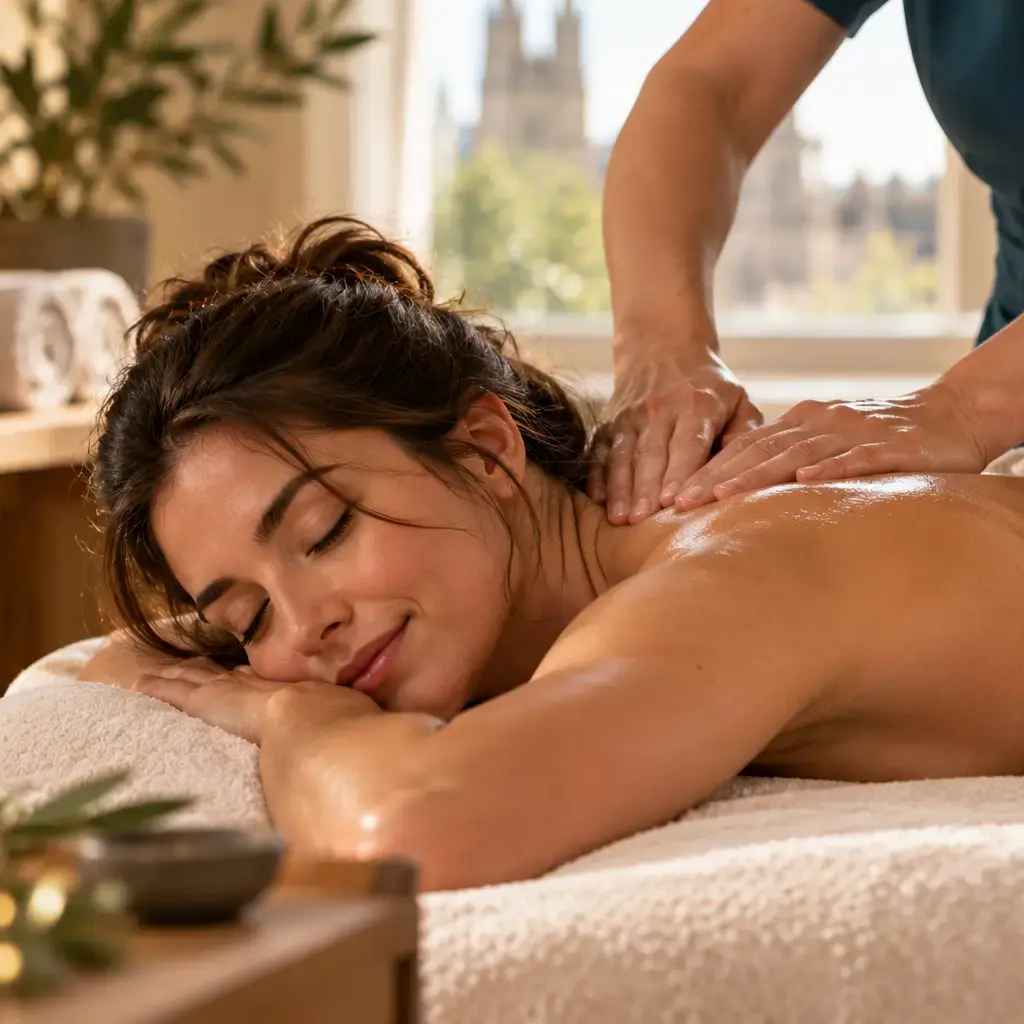
Massage may be useful for associated muscular tension, soreness and stiffness around the hips, glutes and lower back.

Depending on the individual, treatment might involve muscles around the:

•  gluteal region
•  lateral hip
•  lower back
•  thighs
•  hip flexor region
•  surrounding soft tissues

But massage isn’t about “putting the hip back into place” or permanently lengthening a supposedly shortened muscle.

A more realistic aim is to help reduce muscular tension, provide a comfortable change in sensation and support easier movement.

Deep Tissue Massage for Tight Hips

People searching for deep tissue massage in Bath often want help with persistent muscular tightness.

Deep tissue massage may be useful when somebody experiences tension around the glutes, hips or lower back.

But, as I’ve discussed in previous articles, deep tissue doesn’t simply mean maximum pressure.

The hip region contains important nerves, blood vessels and other sensitive structures.

Some deeper muscles are also not suitable for aggressive pressure.

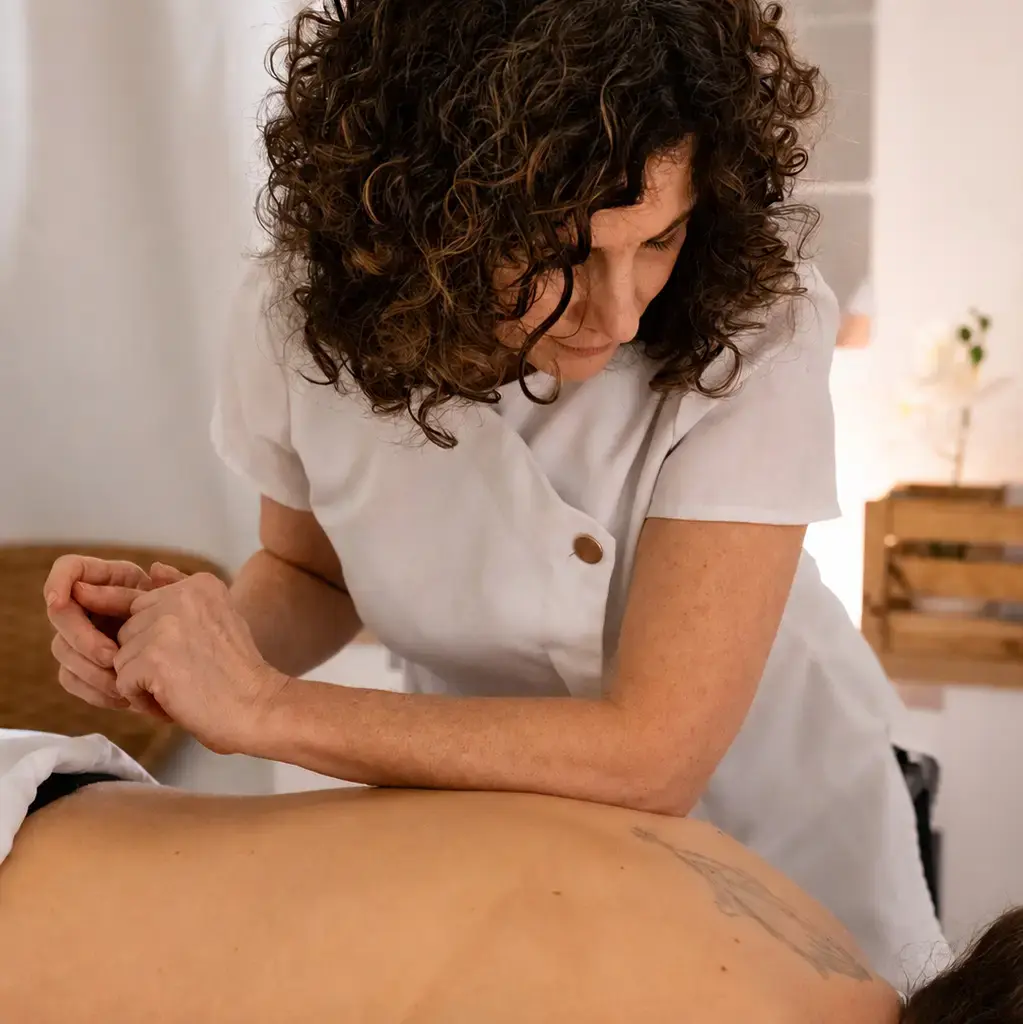
Treatment should therefore be targeted and adapted rather than simply “digging deeper”.

Sometimes broad, slower pressure is appropriate.

Sometimes focused work around the glutes is useful.

Sometimes working on surrounding areas provides a better experience than repeatedly pressing the place that feels tight.

Frequently Asked Questions

Remaining in one position for a long time can leave the hips feeling temporarily stiff. This doesn’t necessarily mean your hip flexors have permanently shortened.

Prolonged sitting can contribute to a feeling of hip stiffness, but “tightness” is a sensation and doesn’t automatically prove that a muscle is anatomically short.

Several muscles contribute to hip flexion. The iliopsoas principally the psoas major and iliacus is particularly important.

Hip and lower-back symptoms can coexist because these regions work closely together, but it is usually too simplistic to say that one tight muscle is automatically causing back pain.

Massage may help with associated muscular tension and stiffness when appropriate. Treatment may also involve surrounding areas such as the glutes, thighs and lower back.

Deep Tissue Massage can be appropriate for muscular tension around the hips and glutes, but deeper isn’t always better. Pressure should be adapted to the individual and the area being treated.

No. Sports massage techniques may also be relevant to people experiencing muscular tension from work, prolonged sitting or everyday repetitive activity.

Not necessarily. The psoas is a deep muscle and direct work isn’t automatically required simply because your hips feel tight.

Not everyone needs the same stretching routine. Movement variety, walking, mobility and appropriate strengthening may also be useful.

Manual Lymphatic Drainage has a different purpose and isn’t used to treat tight hip flexors. If your main concern is muscular stiffness, a therapeutic or Deep Tissue Massage may be more relevant, depending on your individual circumstances.

If you’re experiencing muscular tightness around your lower back, hips or glutes and are looking for a deep tissue massage or therapeutic massage in Bath, treatment can be adapted to your individual needs rather than following a standard routine.

Mediterranean Therapy offers personalised massage treatments in central Bath, including Deep Tissue Massage, therapeutic massage and Manual Lymphatic Drainage, with each treatment selected according to the client’s goals and suitability.

If you’re unsure which massage to book, simply get in touch and explain what you’re experiencing before your appointment.

Visit Me for Your Massage in Bath

Enjoy your treatment at Mediterranean Therapy, located inside The Soul Spa a serene, centrally located wellness space in the heart of Bath:

📍 2 Hetling Court, Bath. Tel: 07378275075
👉 Click and get directions

Relax with a massage. Your expert massage therapist in Bath is ready to help you restore balance and calm, the best experience massage in Bath.

Teresa - Your Spa Therapist

Teresa - Your Spa Therapist

Massage therapist, facials and skincare with 5 star hotel experiences, an expert in a wide range of treatments.

Mediterranean Therapy
2 Hetling Court Bath - Tel: 07378275075

Leave Your Comment

Your email address will not be published. Required fields are marked *

Massage Therapist Posts

Massage & Rejuvenation Services

  • Back, Neck & Shoulder
    Back, Neck & Shoulder

    30 mins – Click to Book!

    £ 35
  • Couple Massage
    Couple Massage

    1 hour – Click to Book!

    £ 140
  • Deep Tissue Massage
    Deep Tissue Massage

    1 hour – Click to Book!

    £ 70
  • Lymphatic Drainage Massage
    Lymphatic Drainage Massage

    1 hour – Click to Book!

    £ 70
  • Hot Stone Massage
    Hot Stone Massage

    1 hour – Click to Book!

    £ 70
  • Pregnancy Massage
    Pregnancy Massage

    1 hour – Click to Book!

    £ 70

Follow me on Social Media

Shopping Basket